
Linguistic Shenanigans
A Writer’s Guide to Romantic Monikers

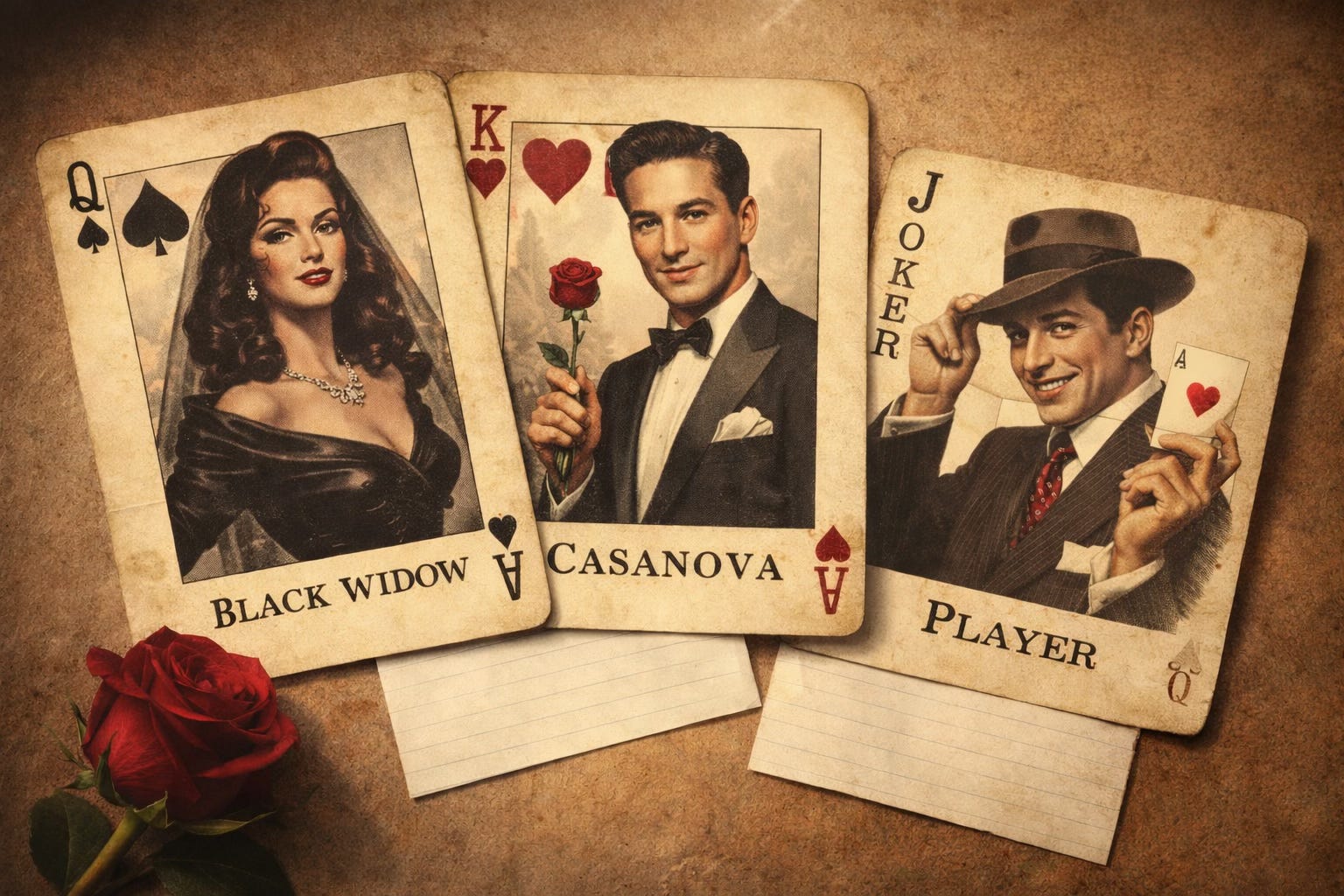
When I was writing my article for the Drive Home series, I wanted to be clever in referencing the male version of mistress. In case you’re curious why, click here. In any case, wouldn’t you know it—there isn’t one.
Not to worry, this isn’t one of those exhausting diatribes expressing frustration about double standards in the name game. Think of it instead as a matter-of-fact and mildly interesting list of the many little monikers we use to describe people and their amorous inclinations.
You may never have a need to reference the male name for having an affair with a married woman. However, just in case, he’d be a side piece, a lover, or—if you’re feeling a little bit fancy—a paramour. These are all gender-neutral, by the way; because on occasion, the English language believes in equality.
That’s admirable.
There’s a surplus of everyday names that have been modified over the years to be more sensitive in ensuring balance in the force… and society. Such as chairman is chairperson. Other examples include, but are not remotely limited to:
Fireman - Firefighter
Stewardess - Flight Attendant
Waitress - Server
Mailman - Postal Worker
Even Star Trek updated their famous line: Where no man has gone before. It’s now “Where no one has gone before.”
All great changes to reflect how our society has evolved to be more inclusive of those who are essentially half the population. I’d be remiss if I didn’t share that my Trekkie husband let me know it was Star Trek:The Next Generation series from the late 80s that changed the phrasing for the starship’s purpose. Nerd (also gender neutral, by the way).
Everyone knows Star Wars is better. Am I right?
Aside from starting a nerd war, let’s learn some of the many names we can use to reference people in our articles and memoirs, along with characters for our stories. Do keep in mind these descriptions are not set in stone and a certain bit of leeway should be given based on the context.
Trophy wife
This is usually an attractive young woman married to an affluent older man. She is often treated as a status symbol for him and stereotyped as lacking intelligence. Her most celebrated qualities tend to be her physical attributes. Naturally, this is essentially used in a playful manner with couples these days, but the phrase didn’t start that way.
Trophy Husband
This is the male version known simply enough as trophy husband. His wife, also commonly older, is enamored by his physical attributes rather his intellect, in keeping with the stereotype. The wife is rich and she is probably living the envy of all the ladies at the country club.
Gold Digger
This can be a woman of any age whose sole purpose is to find a wealthy man to spoil her. She may see the relationship as transactional rather than romantic. If a gold digger does marry, it’s often referred to as a marriage of convenience. And is it ever! Who doesn’t like getting spoiled?
Of course, this isn’t always purely about money—love may actually exist. One of my favorite lines from a movie was said by Marilyn Monroe in Gentlemen Prefer Blondes:
“Don’t you know a man being rich is like a girl being pretty. You wouldn’t marry a girl just because she’s pretty, but my goodness, doesn’t it help?”
Her character, Lorelei Lee is in love with a rich man named Gus Esmond, Jr., and as she says, “it’s just as easy to fall in love with a rich man as a poor man.”
Totally fair.
Gigolo
The male version of the gold digger, and like his female counterpart, he typically has a romantic or sexual relationship with an older woman while receiving financial support. The term originally referred to a man hired to dance with women at European social clubs. Somewhere along the way, the dancing became… optional. This can also refer to a man who is paid for his companionship or sexual services by women.
And to be fair, we’ll need a quote from a movie since I’m all for fair and balanced reporting. In American Gigolo, Richard Gere’s character, Julian Kaye, made being a gigolo his sole career. Julian had a very efficient business model:
“I make women happy.”
Arm Candy
This one has been around for a long time. It originally referred to a man showing off his very attractive female companion at a social event. The idea is all the men will be jealous because “look at this guy with a gorgeous babe out of his league.” It implies the woman has no other value outside of her appearance. She is there to enhance the status or image of the man.
Today, the idiom is more commonly used in a playful way by both men and women and has become fairly gender-neutral. In fact, you can buy your husband a t-shirt that reads, “My wife’s arm candy.” One that mine would wear proudly.
Cougar
This is an older woman—roughly in her 40s or beyond—who seeks romantic or sexual relationships with significantly younger men. The term originally carried a more derogatory tone and was commonly used to call out celebrities or influential women involved with partners many years their junior. These relationships still make headlines today, though the women involved are less often referred to as cougars… because, you know, respect.
I discussed cougars in my article Seasoned Huntress Energy after noticing an older woman in intimate conversation with a younger man. I loved the moment, mostly because we should be able to feel attracted to others without needing to label it.
There is no male equivalent. But…
Silver Fox
An older man, typically with gray hair, who attracts younger women because he appears distinguished and handsome. One might assume this is the male equivalent of the cougar, but it really isn’t. This gentleman isn’t actively seeking younger women the way a cougar is said to pursue younger men. Instead, he’s more like the prey—in a manner of speaking.
All he really has to do is exist with confidence and good hair.
MILF
An acronym that became popular in the late 1990s meaning “Mom I’d Like to F*ck.” Pop culture deserves much of the credit, particularly the 1999 film American Pie, where it became part of the modern dating vocabulary.
The phrase refers to moms who inspire lustful thoughts in younger men. Like Stacy’s mom, who’s got it going on (if you know, you know). MILF was once more commonly associated with women in their 30s, but these days the age range can start with just about any mom in her 20s.
The term has since made its way into mainstream conversation, often used jokingly or even as a compliment. On the more steamy side, the MILF genre is well represented in the adult entertainment industry.
I’m just here to report the news.
DILF
Easy to guess—but, let’s write it out anyway—“Dad I’d Like to F*ck.” This is for those dads who catch the attention of the ladies, often younger women, though not always. Unlike MILF, the term tends to be used a bit more playfully rather than sexually—though it’s certainly that too. Typically, this refers to fathers in their 40s until they graduate to silver fox status. Coincidentally, DILF also a popular genre in adult entertainment.
Social media has become something of a playground for these dads. At the time of writing, the hashtag #DILF returns roughly 597,000 results. (MILF, in comparison, returns about 2.1 million.) These #DILFs like to show off their fit bodies, and some, their parenting skills; offering an idealized image to attract women. In my arduous research—because I care about my work—one of the top posts had over 22,000 hearts. And he still had his shirt on.
Turns out being a good looking and a dad is excellent branding.
Black Widow
A woman whose relationships have a way of ending very badly for the man. The name comes from the black widow spider, which has a reputation for killing the males after mating. For the human female, the phrase is reserved for women who leave a trail of very unfortunate husbands behind them. This suggests a pattern rather than a one off, which is simply called murder.
Side note: she might have been called a murderess once upon a time, but now she’s simply a murderer. That’s called progress.
Bluebeard
This is the male counterpart to the black widow, though the term is far less common. Headlines probably won’t say, “Bluebeard Serial Killer Finally Caught.” It sounds less like a murderer and more like a pirate.
The name comes from a 17th-century French folktale made famous by Charles Perrault. In the story, Bluebeard is a wealthy nobleman who repeatedly marries women and then murders them, hiding their bodies in a forbidden room.
While the character became a cautionary tale about dangerous husbands, the name itself never quite caught on the way “black widow” did. Today it appears mostly in literary references or the occasional true-crime discussion.
Jezebel
This may be a little old school terminology, but it’s not entirely absent in today’s society, nor is it a compliment. Jezebel was a biblical figure—a queen, no less. Over time, she became the archetype of the wicked woman. Whether that reputation is fair—or simply the result of centuries of storytelling—is open to interpretation.
The name isn’t just about being sexually promiscuous, but also deceitful, manipulative, and the flat refusal to conform to social expectations. Today it appears mostly in literary circles, the occasional insult wrapped in wry humor, or when someone wants to sound especially dramatic in the movies.
There is no male equivalent.
Honorable Mentions
Here are a few additional monikers frequently used for men. You may notice they carry a certain air of admiration—or at least a bit of playful approval.
Sugar Daddy
This traditionally refers to a wealthy older man who spoils a woman with money and gifts in exchange for companionship, romance, or sex. The term still carries that meaning, though these days he doesn’t necessarily have to be older—or even particularly wealthy. The only requirement is financial generosity. It’s also used playfully among friends to tease someone whose partner has just bought them an expensive gift. [Read: Gold Digger]
Boy Toy
A younger man who is romantically involved with an older woman, often admired for his looks and enthusiasm rather than his life experience. The term is usually used playfully and sometimes proudly by the couple involved. [Read: Cougar]
Casanova
Named after the 18th-century Italian adventurer Giacomo Casanova, whose memoirs detailed a life filled with intrigue and numerous romantic rendezvous. Today the name is used to describe a man who is charming, persuasive, and very successful in matters of the heart. Casanova carries a certain air of admiration because being good with the ladies is legendary.
Don Juan
Another famous literary ladies’ man, Don Juan originated as a Spanish legend known for seducing women with impressive enthusiasm. He’s appeared in plays, poems, operas—and of course most notably, as Johnny Depp in Don Juan DeMarco. Depending on who is telling the story, he’s is either a charming rogue or someone who has severe commitment issues.
Regardless of how accurate—or inaccurate—these labels might be, they’ve become part of our cultural lexicon. Writers, journalists, and storytellers reach for them because they instantly paint a picture we can all clearly see. Whether that picture is fair is another conversation entirely.
Of course, this list barely scratches the surface. There are countless monikers floating around for every type of relationship, personality, and romantic misadventure imaginable. Language has always had a way of inventing colorful names for people who refuse to fit neatly into ordinary descriptions.
If you happen to know a few I missed, feel free to share them. After all, expanding the vocabulary of love, lust, and human behavior seems like a perfectly reasonable group project.
Leave a comment if you have any names to add to this list!
If you found this article educational and/or entertaining, be sure click the 🩶and follow on social media! This article is free to the public, so feel free to share.
If you’re into storytelling that doesn’t flinch…
The Drive Home is my ongoing memoir series. This a more intimate look at marriage, identity, regret, and the slow work of becoming. It’s where I say the things I once thought I’d keep to myself.
Paid subscribers have access. If this piece felt honest, The Drive Home is even more so. Seatbelt recommended.